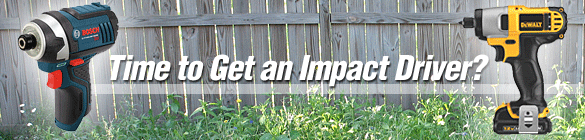
 Every spring I start thinking about projects I want to build in the backyard (instead of the basement). I also start thinking about tools. This year I’m wondering if the tools I’ve been using in my shop all winter will suffice for the projects I want to build outdoors. I’m reasonably sure they’ll handle most of the work, but I’m thinking about adding something to my toolbox: an impact driver. But first I want to consider why backyard projects might call for different tools to begin with.
Scary-Looking Outdoor Fasteners
One of the biggest differences between outdoor and indoor projects is the type of hardware used to hold everything together. Mostly I’m talking about the mere size and weight of the fasteners, which for outdoor projects can be daunting compared to the smaller wood screws I normally use in my shop (see below).
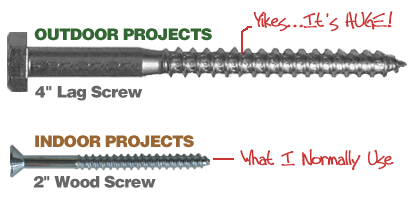
The big and beefy lag screws that hold together projects like decks and gazebos obviously require some muscle power to drive them into a board, which is more power than what my cordless drill is really designed for.
Not that I haven’t tried. Amazingly enough, at first my little drill seemed to work okay at driving lag screws…well, at first anyway. The problem is that pushing a tool beyond its limit not only kills the battery, but also shortens the life of the motor. I guess I’ve learned the hard way that doing outdoor construction calls for tools that are specifically designed for that purpose. And at the top of that tool list is the impact driver.
Impact Driver
Just as the name implies, impact drivers are designed to drive screws — with impact. That extra muscle and punch is exactly what you’ll need to get large outdoor fasteners to go where they’re supposed to go, without ruining the tool (or your nerves) in the process.
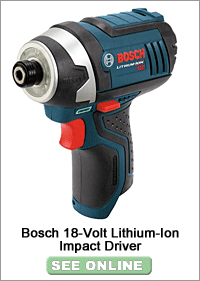
The good news is that impact drivers are sold pretty much everywhere, and that means more affordable prices and lots of choices. Shopping for impact drivers can be a little confusing, though, especially if you happen to be in a store that also sells hammer drills. Hammer drills work great for pounding screws into concrete, but that’s more power than we really need for wood joinery. Look for the impact drivers instead, which are usually located in the same aisle.
The first thing you’ll notice about impact drivers is the small and stubby shape, which I think is nice because it makes the tool fairly easy to hang on to. You might also notice the missing chuck. In its place is a hex socket for inserting special hex-head drivers (no more slipping bits!). Of course what really makes an impact driver unique is the extra torque it unleashes on a fastener — which comes from a special motor that literally “whacks” away at stubborn screws and bolts (sort of like like loosening a bolt by hitting a wrench with a hammer). With most impact drivers, this action kicks in automatically when needed. That can be a little jolting if you’re not expecting it. So to gain a little more control, look for models that provide an impact on-off switch.
Lately I’ve seen some great prices on impact drivers, especially on the 2-drill combo kits. If your old cordless drill is on its last leg anyway, the new combo kits will save you some serious cash over buying both drills separately.